

 🖨️ Print post
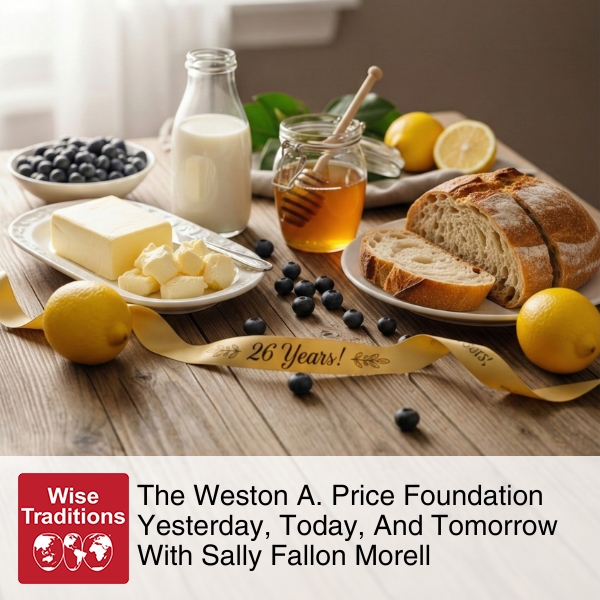
This is the 26th year of the Weston A. Price Foundation (WAPF), a group focused on food, farming, and the healing arts! Today, Sally Fallon Morell tells us how it came to be, as she offers insights on its history and what lies ahead. She describes how she came across the work of Dr. Price and its impact on her life. She explains why she also started the campaign for real milk. She goes over the importance of butter for children’s health and why the foundation is unequivocally against vaccinations. Most importantly, Sally shares stories of lives changed…including her own.
Visit Sally’s website and blog: NourishingTraditions.com
Order Nourishing Traditions and other popular books at New Trends Publishing
Check out our sponsors: Paleovalley and MASA Chips
—
Watch the episode here
Listen to the podcast here
Episode Transcript
Within the below transcript the bolded text is Hilda
Take a stroll down memory lane with Sally Fallon Morell, the founding president of the Weston A. Price Foundation. This is the foundation’s 26th year after all. We thought it would be a perfect time to look back at how it all started, where it is today, and where we are headed tomorrow. This is episode 558. Our guest is none other than Sally Fallon Morrell, the president of the foundation.
She is also a prolific author and advocate for real food for better health. Sally offers insights about how it all got started in her son’s cooking class. She also goes over what inspired her to write Nourishing Traditions: The Cookbook That Challenges Politically Correct Nutrition and the Diet Dictocrats. how she stumbled across the work of Weston A. Price, and why she wanted to get the word out to the world about living ancestrally for good health. She also shares some never-before-heard stories about what has personally impacted her, why she is so passionate about the topic of health.
Before we get into the conversation, I want to invite you to check out a range of nourishing books at New Trends Publishing. This is the home of Nourishing Traditions. That is Sally Fallon Morrell’s, Mary Enig’s Hallmark book. It is the best-selling international cookbook that is changing the way Americans eat.
You can find at New Trends Publishing this book, along with a range of titles, DVDs that supplement the information that you would find in Nourishing Traditions. New Trends offers discounts when you buy books in bulk. Go to New Trends Publishing to find the vast array of nourishing books. Again, that is New Trends Publishing. Buy in bulk for savings so you can have books on hand to gift friends, family.
—
Welcome to the show, Sally.
Thank you, Hilda. It is great to be back.
There is no time like the present to talk about where this foundation has been, how it came about in the first place, and where we are headed. I understand it is our 26th year in existence.
I know it’s hard to believe. How many years have gone by? I do not know how I got here, or we got here. It just all happened. I did not plan anything.
I cannot wait to hear about all the happenstance, what led you to create this foundation. Let us start with the story of your invitation to your children’s school to help bake cookies. Tell us about that.
Inspiration For Nourishing Traditions
It was when my third child was in about the 5th or 6th grade. A teacher called me, and she said, “Mrs. Fallon, we know you love to cook. Would you come in and do cookies with the children?” I said, “Sure.” I got all my ingredients together, got in a batch of sweet nectar. I had almonds, spices, all my pans, everything. I go in, take them out of the bag. She said, “No, that is too hard for children. We are just going to cut this dough.” I put a dough in.
That is so crazy.
I did not want to make a scene, but I was truly angry. I thought, “I would like to teach these kids how to cook. Show them that nothing is too hard for these kids.” It was a church school. I asked if I could do this class. They said yes. I advertised, “Do a class in French cooking every Wednesday after school.” I put a notebook together, which really was not the basis, but the start. There are Asian traditions. I was using butter. I used broth, but I had not gotten into the special preparation of grains or fermented foods, anything.
How did the children react? Here, this teacher was saying, “They cannot do more than chop up the little Pillsbury cookie dough roll into little quarters.” You were inviting them to do all these things, make reduction classes.
That is what I interpreted. She said, “Come, do cookies with the children.” I interpreted that to mean to actually put the cookies together. The children, I do not think they realised what was going on. It’s just me, the teacher talking. Anyway, we did reduction sauces. We did stews. We did soups. We made broth. We did a pie crust, which is hard. The kids absolutely loved it. They ate every bite. Much better than my children. They ate every bite. It just showed me what an interest there was. That started my little notebook. That was about three years before I got the idea to do Nourishing Traditions.
How did that idea come to you, Sally?
We had just moved back to Washington, DC. We set up a fax machine in my husband’s office. I sent a fax to a friend of mine saying, “Mary Ann, just seeing if our fax works.” I immediately get this fax back. She says, “Yes. Sally, I have been thinking we should write a cookbook together.” I turned the paper over. I said, “Are you kidding? There are thousands of cookbooks out there. Nobody needs another cookbook.” I sent it back to her. She planted the seed. I just could not get this idea of writing a book out of my head. It took over.
I thought, “If I were to write a cookbook, how would I do it?” I thought, “I would try to make the work of Weston Price more accessible to the population.” Eventually, I called her up. I said, “Mary Ann, I am going to write a cookbook, but I do not think we should do it together because you do not cook the same way I do. You do a lot of chocolate, pasta. This cook would not have that in it, but I want to still be friends with you.” We are still wonderful friends even today.
You forged ahead, but I am curious. Let us back up a little bit because you said you wrote the book in part to lift up the work of Dr. Price. When you were making the cookies with the kids, you started your notebook, and you said you did not know about the proper preparation of grains, etc. How did you come across the work of Dr. Price?
I found Dr. Price’s book in a bookstore in and we were living in Washington at the time. This was called the Yes Bookstore. It was on Wisconsin Avenue. I found a hardback version there. I only had one child at the time, but she was very cute and healthy. I was raising her on cream. I could not get raw milk, but I gave her cream, butter, and eggs. This was the time when the low-fat message was coming out. Low-fat for children. I just knew that this was wrong.

One of the reasons I knew it was wrong was because my health challenge all my life has not been high blood sugar, but low blood sugar. If I ate sugar, my blood sugar would drop. I turned into a cooking monster. I knew this would happen to children, too. If you fed them low-fat diets, they would be cranky all the time. I discovered his book. It’s about the diets of these people. They ate butter, whole milk. I knew I was right. I just continued on. The stuff about the grains, the lack of fermented foods, I did not really discover until I was working on the book.
When did you decide to partner with Mary Enig in writing that book?
Collaboration With Mary Enig On The Science Of Fats For Nourishing Traditions
I started writing the stuff about fats. I knew that I needed help on this section because I did not have a science background. There was a little newsletter I got. I wish I could remember the name of it, but it had an article about Mary, a PhD in lipid chemistry. She lived in Silver Springs. That was near me. I contacted her. Said, “I am working on this book.” I offered to pay her as a consultant. I sent her the manuscript. This is now. We are just talking about the first 60 pages. She called me up.
She said, “You have the right conclusions, but you do not know what you are talking about. You need the science. Why don’t you come out to my office? We will go over this.” In 2 or 3 meetings, I had this crash course in lipids. I kept asking for her advice. Finally, I said, “I just cannot pay you anymore. Would you be willing to be a co-author, and then you could get royalties?” She agreed to that. She is still getting royalties. Her estate is. That is how I met Mary.
What is cool about this to me, Sally, is that you knew instinctively that fat was good for you, even if you did not know the science behind it. You knew it was a wise tradition. As you like to say, “Modern science is catching up to ancient wisdom.”
We like to see the scientific validation of traditional wisdom. That is really exciting. It is with the grains. The person who introduced me to this about the grains was Jacques DeLangre. He was the father-in-law of Selina DeLangre, who has the Grain & Salt Society. I was going to put in about salt. We had a long phone call. He said, “You need to talk about sourdough bread and soaking grain.” He pointed me to this book that was in French. That was very fortuitous. The same author had written a book on sauerkraut and fermented foods, also in French. That is where I found out about all of that. It was not in Dr. Price’s book.
That is right. That is what I like about the foundation, too, that you took his work. You are making it more accessible exactly as you said. You did not stop there. You continued with the research to find out what other commonalities are found in traditional healthy diets.
Corresponded with the science, and then we put it in. It is very interesting because one of the big mistakes I made in my life was I learned about granola. I started making granola back in the ‘70s, ‘80s, maybe in the late ‘70s, this started. I made delicious granola, I must say. I was eating it all the time. I got really sick. I could hardly function.
After I ate granola, I would have to lie down due to a terrible digestive pain in my gut and an ache. When I found this book in French, this must have been the late ‘80s, I guess. I learned about soaking grains. I thought, “This is why granola makes me so sick and tired, because this really is not even cooked. It is just baked.” Sorry, as I was, I could not put granola in the book, even though I made it, but it did not fit with the plan.
The Founding Of The Weston A. Price Foundation & Its Core Mission
You wrote the book. You started to get some traction. I guess people were interested. I have heard so many people I have encountered are like, “Yes, my mother has that book,” or “My mom raised me that way.” Why did you start the foundation if you were already, like I said, getting some traction with the book itself in terms of getting notoriety or notice for Dr. Price’s work?
At that time, I was on the board of the Price-Pottenger Nutrition Foundation, which was tasked with preserving his work, which they did fine, but I felt that they were, let us just say, there were a lot of older gals, which of course is where I am now. I just thought we needed to get this out to the public more. It was like a little private club. If you knew about Dr. Price’s work, then you were part of the club.
That is great, but it was so needed. Especially, we needed a counter voice to all the propaganda about low fat, propaganda against butter, and so forth. I was very concerned about the milk. How the milk was damaged by pasteurisation. Once the book came out, Mary, I said, “Let us set something up that continues, and has a magazine that can keep all of this information in front of the public.” That is what we did. We set up the Weston A. Price Foundation in 1999. Tom Cowan was on the board, Mary, Jeffrey Morrell, my husband at the time. Here we are.
What was the principal mission of the foundation, would you say?
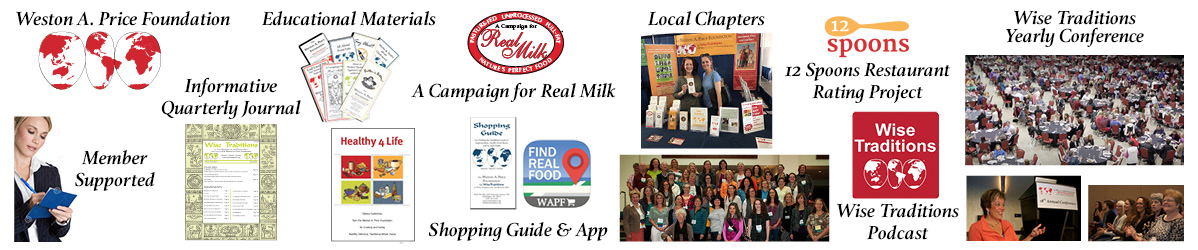
To educate people about the work of Weston Price, to educate about what constitutes a healthy diet, especially for preconception, conception, and children. Not only educating, but also finding the food that we would recommend. At the same time, we set up A Campaign for Real Milk. They have a website where people can find raw milk. We set up the chapter system so people could find these foods in the area where they live.
It must be so gratifying for you to see. Now we have hundreds of chapter leaders worldwide. People are accessing real food. The only job of the volunteer chapter leader is to provide a list of resources for real food in the area.
We can do other things too, but that is the main job. I said this at the chapter region meeting, so I live out in the country now. It is the stick out here. There is not a big food culture in Southern Maryland, but the local Food Lion is not the top of the line, but they have grass-fed butter. They have pastured eggs. They have kombucha. They have organic fruits, vegetables. They even have a little bit of pastured meat. That is real progress. You would not have found any of those things in any supermarket ten years ago.
Significant Successes: Campaign For Real Milk Expansion & The Healthy Baby Gallery
Tell us about the Campaign for Real Milk. What progress have you seen there?
That is really gratifying. We set that up in 1999. Pete Kennedy worked with us from the very beginning, filing all the raw milk laws in all the states. We always had that little map showing what the laws were in each state. When we started, there were 27 states that allowed the farmer to provide raw milk in one way or another, either through retail sales. There were states with retail sales, on-farm sales, delivery, pet milk, or cow shares, herd shares.
Now we are up to 47. We were only lacking three states before we had all 50 states. Raw milk has just exploded. There are probably 20, 30 million people drinking raw milk. The number of permits has exploded. Here in Maryland, we got the first pet milk permit. Now there are several dozen in the state. It is really fun to see raw milk grow and grow in response to demand and need. To me, the Real Milk website is just the perfect beneficial use of the internet, helping people find things that they could not have found before.
You can plug in your zip code. You can find out what is available right near you. Tell me more about some of the other gratifying things, some of the other successes you have seen over the years with the foundation.
The most gratifying thing to me is the Healthy Baby Gallery. The letters we get from the parents. They are so grateful. These babies are so beautiful. These are our hopes for the future. We have so many problems, and they are the ones who are going to solve them. We are too old or too busy, but those wonderful, healthy, smart, dedicated Weston Price babies are going to change the world.
I love that so much. If you want to see these healthy babies, you can go to the last few pages of the journal. It is in the back of the journal. All of these beautiful faces, these pictures that parents have submitted, saying, “Our child is a WAPF baby.” They talk about their preferences. You can see how alert, happy they are. It is just, you are right, it is fabulous.
They do not need braces. They do not cry. They do not cry. When they grow up, they do not need braces. We have posted all of these on the website under Children’s Health. You will see some of those healthy babies.
Obviously, these parents are thrilled at what they see in their child. Some parents come across us and can do that comparison that Dr. Price did as well. In other words, they can see the poor health of their older children, the improved health of the latest baby, whose parent, whose mom, had the Weston Price diet.
They have got the cod liver oil, the raw milk, and so gratifying. No vaccinations. The thing is, when they are healthy, even if vaccinations work, they do not need them. They do not need that risk because they are healthy. They are on a good diet.
Controversial Stances
That leads me to one of the controversial stances at the foundation, vaccines. I will never forget when I became a chapter leader in the early days. I was like, “I do not want to tell people about this aspect. It might scare them away or something.” What made you stand so strongly in such conviction, Sally, at a time when everyone seemed like pro-vax?
It is interesting when you look back on your life, why things happened. My little brother, who was ten years younger than I, almost died after the polio vaccination. I remember I had gone out in the morning to an art class across the school, across the street. I went to this art class. I came home. My mother said, “Come into the bedroom.” My little brother, who was just this darling, cheerful, always laughing little boy, about two years old, was lying in the middle of the bed.
He shrank to half his size. My mother was standing there saying, “I just do not understand it. We were at the doctor’s yesterday for his polio vaccination. Dr. Keebler said he was the picture of hell.” It was only later that I put those two things together. I do not think my parents ever did, but the doctor said, “He picked up a bug in the swimming pool.”
He survived without any apparent damage, but it was touch-and-go. It was very scary. When it came time to vaccinate my children, I just kept remembering that. Of all my four children, only one got a vaccination. That was her first pediatrician visit. It happened so fast. I was not given any choice at all. There she was giving the vaccination. I just stopped going to the pediatrician. I do not know what happened again.
The other thing was that there was no literature. There were no books. I really was looking for a book. I do not know. The first book was by Neil, I cannot think of his name, but that was a few years later. I did everything I could to keep from vaccinating the other children. I did not do any more vaccinations for my daughter. One of the things I am proudest of is that I have five grandsons. Not one is vaccinated.
That is so wonderful. In this case, again, you were following your intuition about it. What science started to bubble up that you were like, “This goes to show what I thought all along, that this vaccination program was not a good one.”
Connection with autism. My little brother had meningitis, which is a neurological assault. It just made sense to me. There were studies that started to come out showing that the overall health of the unvaccinated children was so much better. Fewer allergies, asthma, and respiratory disease. We had a vote on the board. I do not think Mary was still on the board at that time because I do not know if she would have agreed with us, but we voted to make that a policy of the foundation. It was a unanimous vote. That was about 2005.
Again, the healthy babies. Many people have testimonials of improved health since they started adopting the wise traditions diet. Also refusing vaccines. Can you tell us a story? Does a story come to mind, Sally, of someone whose life was changed by the work of the foundation?
Not specifically because there are so many. We get letters all the time. We publish them in the letter section. We put the babies in the journal. I do remember two letters. They were back-to-back one month later, of gals who had been diagnosed with osteoporosis. They had the DEXA scan. “Yes, you have osteoporosis.” Both of them started drinking raw milk. Went back a year later for a DEXA scan. They said, “There must be some mistake here. You do not have osteoporosis.” They said, “Yes, you diagnosed me with osteoporosis.” They were just flummoxed. They said, “We have never seen before. We have never seen osteoporosis reversed.” Just with raw milk.
That validates your Campaign for Real Milk. Let us talk about that for a minute. Why do you call it a Campaign for Real Milk instead of a campaign for raw milk?
There was something in Britain called the Campaign for Real Ale that was in the ‘70s, ‘80s, ‘90s to bring back real beer, craft beer, stuff. I modeled it off that, a Campaign for Real Milk. It is not just that it is raw. It is that it is both those. It is pasture-raised. All the things, terrible things that we have done to our milk. We have taken the cows off the pasture. We take the fat out of the milk. We pasteurize it. What you have left is the poison that causes anaphylactic shock, asthma, who knows what else. Diabetes, all kinds of horrible things.
People think they are intolerant of dairy or lactose intolerant when actually it could be the pasteurization that is making any nutrients in there difficult to digest.
We call it pasteurization intolerance.
I am curious now. We have done a little bit of review. Looking ahead, where would you like to see the foundation in the next 5, 10, or even 15 years?
Future Goals: Succession Planning & Tackling The Dietary Guidelines For Institutional Change
We want it to be around in 100 years. We personally look at the next five years. Kathy, I am not getting any younger. By the way, big hats off to Kathy. Kathy started working for the foundation when we were still in my house. Quite chaotic. The boys are running through. Kathy has been with us this whole time. Grown into her wonderful work as executive director. I talk about this a lot. We are definitely looking for someone young-ish to grow into her role at the office.
That would be a full-time position. On the board, we are deliberately bringing young people on the board. Just bringing Dr. Ben Edwards on the board, who is a doctor, I think, in his 50s or something. That is young. Believe me, that is young. We are trying to bring young people onto the board. When I am gone, I will haunt them if they do the wrong thing. It is all taken care of.
What do you think will be the next big hurdle? Let us say all 50 states agree that raw milk can be legal in some way or form. What do you think will be the next thing that the foundation will want to tackle?
We are working on the vaccination thing. We have Kendall Nelson working on action alerts. I am sure you have at some point gotten an action alert for your state. The other thing is the school lunches. I always tell chapter leaders, “Do not waste your time on school lunches because it is cast in concrete in dietary guidelines. What you can do is convince moms to make their kids’ lunches for now.”
What we need to do is, Nina and Ty Schultz have said this, “We need to take the dietary guidelines away from the Department of Agriculture, where there is so much invested in selling processed food, grain-based foods. Take those away from the Department of Agriculture. Just start over.” The opposition to doing such a thing is intense because these guidelines have resulted in a huge market for processed foods. Just like the SNAP program.
We need to remove the dietary guidelines from the Department of Agriculture, which is heavily invested in promoting processed and grain-based foods, and start over with a fresh, unbiased approach.
No, you can buy Pepsi Cola in SNAP. The food companies love SNAP. By the way, I saw a meme the other day. It was a window electronic benefit transfer, EBT. You could buy lottery tickets in some states. You can buy liquor in some states with EBT. I digress, but anyway. In a more general sense, we need to change the public’s perception of what constitutes a healthy diet.
If you go to the hospital for anything, you get this horrible advice. “Do not salt. I just spent a week putting saline solution into you to help you recover.” They tell you not to salt. We definitely need to change the perception. That will happen slowly, but it will happen on the grassroots level until people would just laugh at the diet, their guidelines. They are so ridiculous. Still, most people believe them today.
I wonder, because of what you have even coined the upwising of the crowd. People on social media, people are getting information not just from the supposed experts, but from each other. They are realizing, “A mom tells another mom, raw milk healed my son’s eczema.” The next thing you know, people are not turning to the people in the white coats anymore.
That is what has got to happen. We need to feel sorry for these doctors who got abysmal training on what constitutes wellness. Little by little, the dietary guidelines will just become a laughing stock.
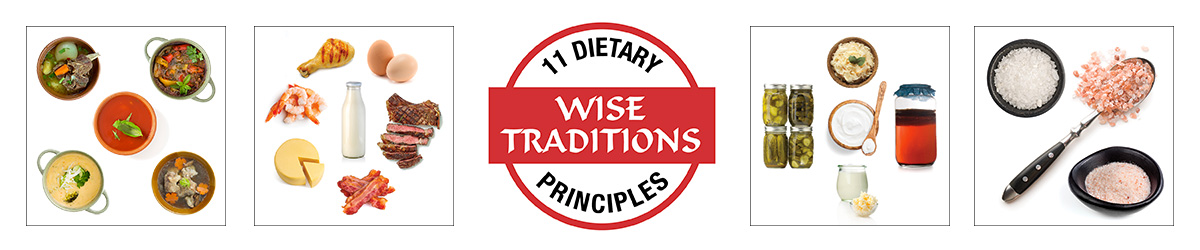
I would hope that the wise traditions principles would become mainstream. They are guidelines in a way for people to look at how our ancestors nourished themselves deeply, to follow suit. Do you want to share one of your favorite principles of the eleven principles?
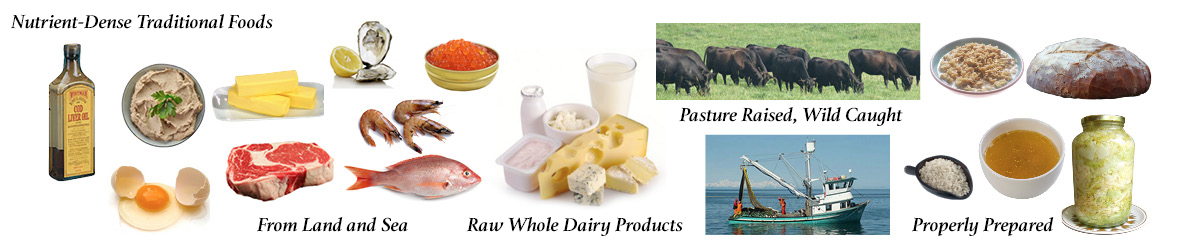
Let us see. My favorite is the third one because it was the most important, the nutrient-dense diet, with very high levels of minerals, but extremely high levels of the fat-soluble vitamins, so A, D, and K. We really need to make an effort to eat the foods that provide us with these fat-soluble vitamins. One of the things we have learned over the past few years is that vitamin K, which was called Dr. Price’s X factor. It is in butter. It is in egg yolks. It is in cheese. The real source of vitamin K is poultry fat, poultry livers.
Chicken skin, not skinless chicken breast, chicken skin. That is why people love wings because there is such a high fat-to-meat ratio. The livers, the duck fat, goose fat. I would really like to see a demand and production of duck fat, goose fat. I remember I had a friend in Los Angeles who was from Denmark. She was a beautiful woman, beautiful face. She said when she was growing up, they had goose fat sandwiches. She was embarrassed about it. She said, “Doesn’t that sound awful? My mother would spread goose fat on the bread, sprinkle herbs on the goose fat sandwiches when we came home from school.” That was a tradition. Europeans do a lot more goose and duck than we do.
As you have said, when we nourish ourselves well, it shows. Of course, Dr. Price said, “The teeth tell the tale.” I have heard you say before, when people have Hollywood celebrity good looks, it is likely because they were nourished well when they were even in utero, likely.
In our store, we have a copy of a menu from one of the movie studio cafeterias. We have a pin on the wall. You could get certified milk. You could get a glass of cream at this cafe. There are five different types of liver dishes on the menu. There were oysters. There was also caviar. This was just for the cameraman, the stuntman, everything. This was the cafeteria. It is Warner Bros.
It is Warner Bros., too, because I have seen that. It was from the 1950s or something, right?
Yes, 1951 or something.
Sally, why is it then, when we look around today, though, just at everyday people, like people look more depressed, anxious? Their faces are narrow. What are they missing?
Unfortunately, you can only build the body structure during the growing years. They were basically following a processed food dietary guideline. They were not getting butter. They were not getting cod liver oil. Just giving your kids butter alone will be very helpful for their health.
Are you optimistic or pessimistic about the future?
I am an incurable optimist. I do not say there is not going to be a lot of suffering. We are going to see a real shrinking of the population. What I call the natural selection of the wise is what is happening. The ones who are wise in their dietary choices, loving in the sense that they will make these efforts for their children, themselves. They are the ones who will reproduce. This is nature’s way. It is a process of selection.
We’re going to see a shrinking of the population. The “natural selection of the wise” is already happening. Those who make wise dietary choices—and who are loving enough to make these efforts for themselves and their children—are the ones who will continue to reproduce.
Sally, what do you say to those, as we start to wrap up? I want to ask, what do you say to critics who suggest that the foundation is out of its lane when we go out on a limb, let us say, about EMFs or viruses, or even vaccines?
I do not listen to critics. Too bad for them. What I have noticed is that they do not talk about us very much. That is because the last thing they want is for this to become mainstream. There is no such thing as bad publicity. They were criticizing some of the newspapers. People would go to the website, have a look. It is very interesting to me that we have been largely ignored.
It is interesting. It is curious.
Very curious. I get calls from reporters quite often. Got one from, I think it was the Wall Street Journal, and she said, “We are doing an article on raw milk, lack of science behind raw milk.” I sent her a list of studies about asthma, a respiratory disease. Did not reply. She did not do the article either. She just did not do it because if she had any sense of honesty at all, she would have had to say that I provided her studies. Science, real science. She had to write an article based on the idea that we did not have any science.
You have proved her wrong. Our critics are sometimes not vocal at all. As you said, they do not want to bring attention to the foundation. Do you ever or were you ever concerned that somebody might try to stop or shut down the foundation altogether?
Yes. We had a few incidents about 10 or 12 years ago where I thought that people were trying to do this, but we worked through it.
That is wonderful. I am so happy that you joined us. I am so eager to get this out in the 26th year of the foundation. I have often remembered something that you said a while ago to me. You said, “You know, we are never going to be hip. We are never going to be necessarily cool or trendy.” That is the beauty of it all, really, is the fact that these principles are based on ancient wisdom. That is why they are validated time and time again.
Also, I say it is not in our mission statement to be popular. It is in our mission statement to be right. If we are also popular, that is fine. Our mission statement is to have accurate information. Our mission statement is to be right.
That is powerful. I am going to pose to you now the question I love to pose at the end, which you have heard a few times, but I must repeat it. If the audience, Sally, could only do one thing to improve their health, what would you recommend that they do?
That is to eat lots of butter.
That is wonderful advice. Thank you so much for your time. On behalf of the very organization that you founded, the Weston A. Price Foundation, thank you for your time today, Sally.
Thank you.
—
Our guest was Sally Fallon Morrell. Visit her website, Nourishing Traditions, to check out her blog. For the transcript for our episode, visit our website, Weston A. Price, and click on the podcast page. Now for a recent review from Apple Podcasts. DesertLove82 says this, “The one, the only, nothing else compares. The Weston A Price Foundation has been ahead of the game since the ‘90s.” Thank you so much, DesertLove, for sharing your review. You too can leave us a review. Go to Apple Podcasts. Give us a bunch of stars. Tell the world why our show is worth listening to. Thank you so much for tuning in, my friend. Stay well. Remember to keep your feet on the ground, your face to the sun.
About Sally Fallon Morell
Sally Fallon Morell, MA, President, is best known as the author of the best-selling cookbook, Nourishing Traditions®: The Cookbook that Challenges Politically Correct Nutrition and the Diet Dictocrats.
She also founded A Campaign for Real Milk (www.realmilk.com). At its inception in 1998, the website listed only twenty-eight sources of raw milk in the U.S. Today there are over two thousand, with many hundreds more not listed. Raw milk is the fastest growing agricultural product in the US; this growth has been largely stimulated by the information provided at realmilk.com.
She lives in Brandywine, MD. She is the mother of four and has five beautiful grandsons, all brought up according to Nourishing Traditions® principles.
Important Links
- Sally Fallon Morell
- Nourishing Traditions: The Cookbook That Challenges Politically Correct Nutrition and the Diet Dictocrats
- New Trends Publishing
- Campaign for Real Milk
- Weston A. Price Foundation
Episode Sponsors
🖨️ Print post

This was great. I really enjoyed the history of WPF!
This was excellent. The history of WPF was fascinating to me!
Honestly, it’s wild how people still don’t realize how much our diets affect everything! Like, I started using real butter instead of that margarine junk and the difference was noticeable overnight. What’s everyone else doing here that’s changed their health game?